
Online CNC Machining Factory
| Standard | Certificate number | Scope |
|---|---|---|
| ISO 9001:2015 | 116024/A/0001/UK/En | Machining of metal parts |
| IATF 16949:2016 | 131941/A/0001/SM/En | Manufacture of CNC metal machining parts (excludes product design, Clause 8.3) |
| ISO 14001:2015 | 116024/B/0001/UK/En | Environmental management related to machining of metal parts |
A certificate number is only useful if you can check it. The numbers above are stated so you can call the registrar and confirm scope, expiry, and holder — a factory that hides its certificate numbers behind "fully certified" is asking you to trust the claim instead of verifying it.
How does material verification protect cost?
Incoming bar is XRF-checked against the mill certificate before a chip is cut, so a mixed or mislabeled lot is caught at the door. A wrong alloy caught early costs nothing; caught in the field, it is the most expensive failure there is.
The check also closes the loop on the material lever. If you specify 6061-T6, you are paying for 6061-T6, not for whatever the warehouse happened to have; the XRF reading against the mill certificate makes that transaction honest. The material certificate with a heat number then follows the lot through the shop and onto your dock, so a part can be traced back to the heat it came from — the same discipline that lets a factory isolate a problem to a single lot instead of treating an entire order as suspect.
Can a buyer visit the factory before ordering?
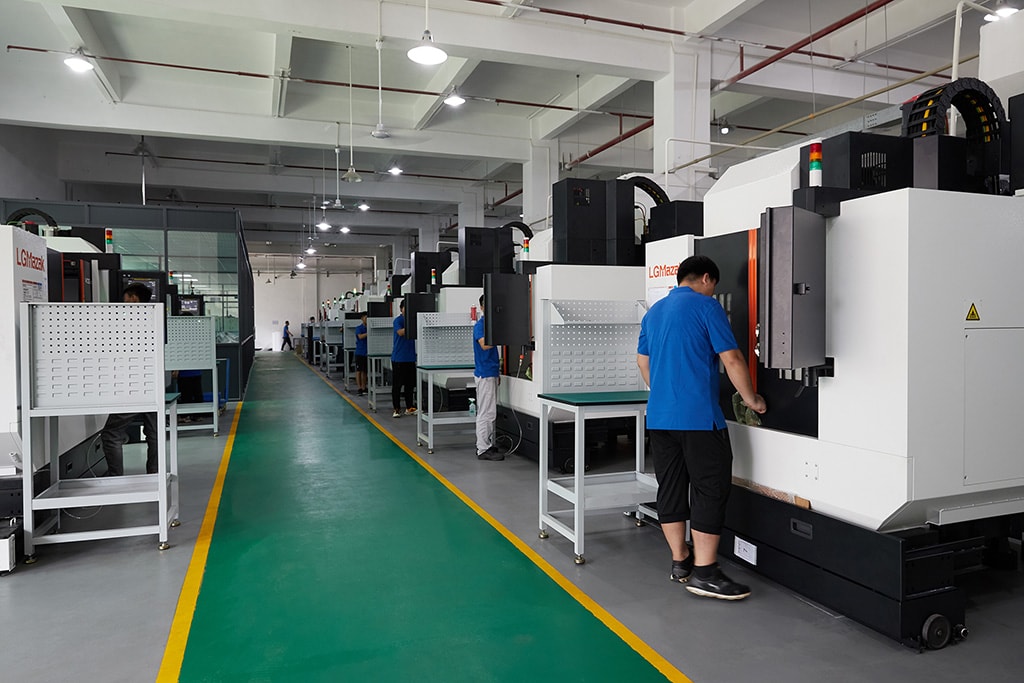
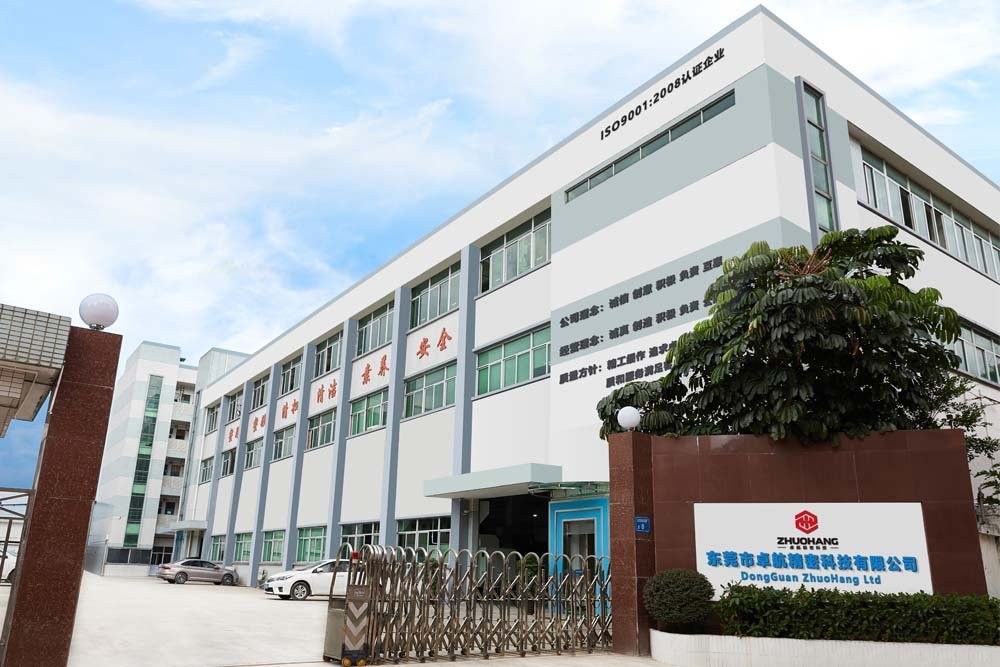
A site visit is the strongest due-diligence step you can take, and a manufacturer that claims cost efficiency should welcome it. You can tour the floor, watch the inspection bench, and review the quality records in person.
Visits are arranged through the sales contact. The address is No. 8, Shuibian Songyuan Road, Hengli Town, Dongguan, Guangdong, China 523470.
A visit also answers what a photo cannot: whether the machines run, whether the inspection bench is staffed, and whether the quality records are live rather than staged. Walk to the CMM and ask to see the last job's report. A plant that hands it over without hesitating has nothing to hide from its own data.
What should a buyer confirm about the factory before committing?
- The legal identity matches public records.
- The machine mix fits your geometry and cost target.
- The material is XRF-verified, not assumed.
- The certificate numbers are stated and verifiable.
How do you verify the factory's claims?
| Claim | How to verify it |
|---|---|
| Legal identity | Registration number against public records |
| Machine mix | Walk the floor, count by process |
| Certifications | Certificate number with the registrar |
| Material traceability | Mill certificate with heat number follows the lot |
What should a buyer confirm before the first order?
- Ask for the registration number and check it against public records.
- Ask to walk the floor and see the machines by process, not by photo.
- Ask for the certificate numbers and their stated scopes.
- Ask how a mixed material lot is caught before it is cut.
- Ask what the routing is for your specific part, feature by feature.
What does the machine mix mean for your lead time and cost?
Machine count is not vanity — it is slack and redundancy, and both land on your schedule and your price. A floor with 100+ production machines can start your job when you need it rather than when a spindle frees up, which keeps the lead time predictable and the assembly schedule intact. It also means redundancy: if one machine goes down for maintenance or a breakdown, another takes the job and your date does not move with it.
The mix matters as much as the total. 50+ 3-axis centers cover flat and prismatic parts, 20+ 4-axis and 20+ 5-axis centers cover the multi-face work, 25+ lathes cover round parts, mill-turn centers handle concentric parts with milled features, and 7+ grinders hold the ±0.002 mm surfaces. That breadth means most of a part's operations happen on one floor under one roof, which shortens the chain and removes the mark-up and risk of subcontracted steps. A part that stays put is a part whose cost stays visible.
How does the machine mix route a part to its cheapest process?
Routing is where the machine mix becomes a cost decision. A round shaft goes to a lathe, because turning is the cheapest way to make something round. A flat bracket goes to a 3-axis mill, because a prismatic part machines fastest there. A housing with features on four faces goes to 5-axis only when the saved setups justify the rate. A bearing seat goes to the grinder, because only grinding holds ±0.002 mm. The factory routes each feature to the cheapest machine that holds its tolerance, and the DFM review does that work on the drawing before the quote.
The test is a single question: ask a factory to walk your drawing through its routing and explain each hand-off. A shop that can name the process per feature — turning here, milling there, grinding only on the seat — has planned the cost. A shop that answers "machining" for everything is running the part on whatever machine is free, and the price reflects the accident rather than the plan. The routing is the paper trail of cost-driven selection, and it should be visible on every quote.
What equipment verifies the parts?
A factory that machines to a micron but measures with a ruler cannot vouch for its own tolerance. The inspection bench here is the same class of equipment a buyer would use to audit the floor: Hexagon GLOBAL S CMMs for dimensional verification, a laser microscope and a profilometer for surface finish and profile, an XRF spectrometer for material composition, and hardness, coating-thickness, salt-spray, and tensile testers. In total, 20+ inspection instruments sit beside the machines, not in a room two weeks away.
The point of that bench is the report, not the hardware. A CMM report with measured values against your drawing, an SPC chart with a computed Cpk, a material certificate matched to an XRF check — those are the documents that turn a promise into a fact. They are produced on the floor, next to the machines, so a defect is caught at the machine where it costs the least rather than at your dock where it costs the most.
How does location matter to landed cost?
The factory sits at No. 8, Shuibian Songyuan Road, Hengli Town, Dongguan, Guangdong, China 523470 — in the Pearl River Delta, one of the densest manufacturing regions in the world. Location is a quiet cost input that most buyers skip: it shortens the supply of raw stock, keeps secondary processes like anodizing and heat treatment within reach, and puts the factory near the freight lanes that move parts to the ports.
For an overseas buyer, that geography shows up as shorter, more predictable lead times and fewer delays between the machine and the ship. A factory in a supply-chain-rich region can get material and finishing without waiting weeks, and that speed is a line on your cost of ownership — a part that ships sooner is a part that never forces an expedite. Location is not a slogan on a brochure; it is a freight and schedule input, and it belongs in the same column as the machine mix and the tolerance.
What this shop actually runs
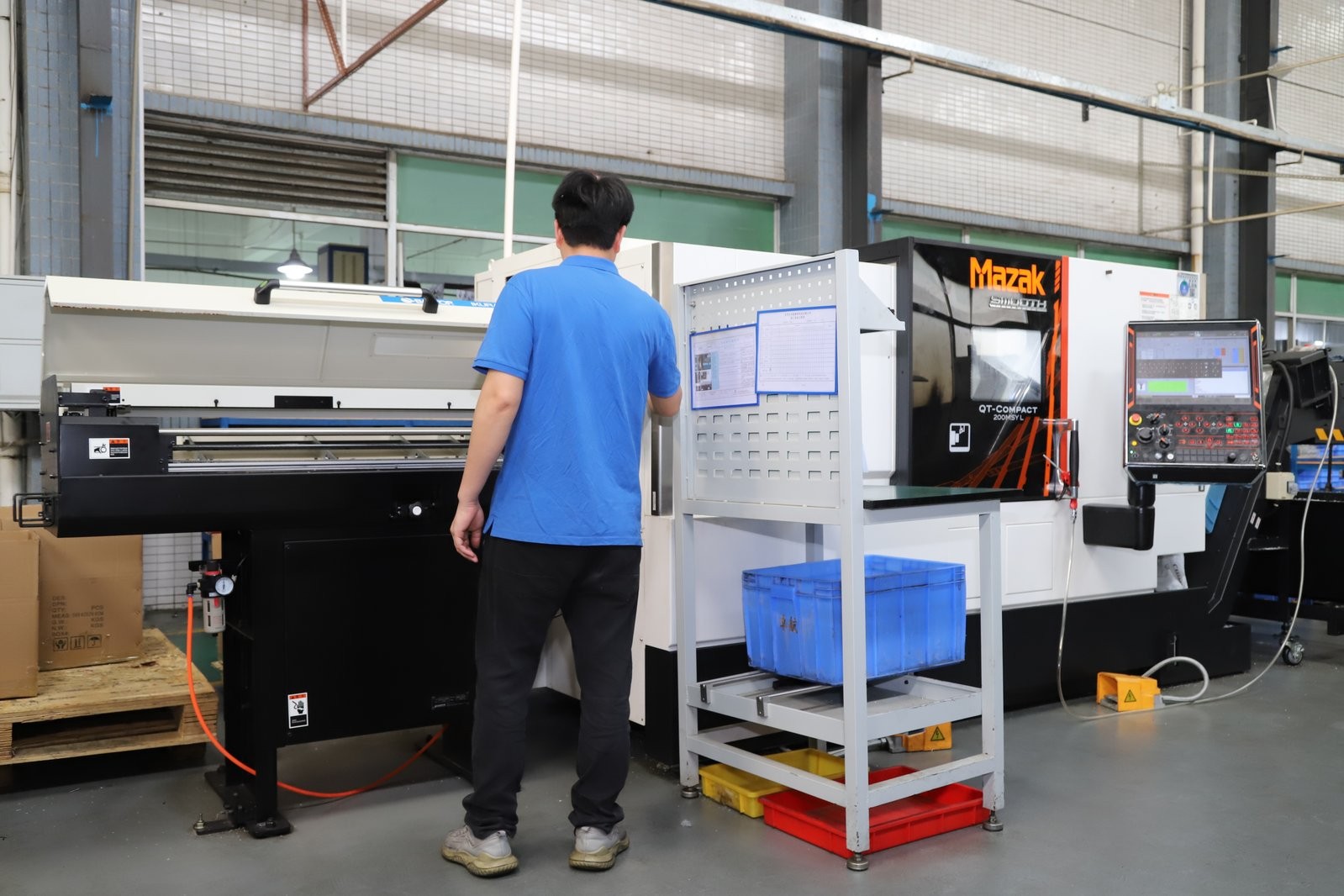
We machine every part in our own 6,800 m² plant in Dongguan, China, on 100+ CNC machines with 100+ staff. The machine list by category:
- 5-axis machining centres (10+) - Mazak VARIAXIS I-600 (510/910/510 mm travel, 12,000 rpm, 22 kW, 71.6 N·m, 30-tool BT40) and Mazak INTEGREX I-250H S (B-axis 0.0001°, 24 kW, 124 N·m, 38-tool HSK-A63). Intended for compound-angle parts, single-setup multi-face prismatic work, and aerospace fittings where datum transfer loss is unacceptable.
- 3-axis / 4-axis machining centres (50+) - Brother SPEEDIO S500Z2N / S700Z2N (10,000 rpm, 14/21-tool ATC, 0.7 s tool-to-tool, Z-axis 2.2 G) and Mazak VCE-430A L / VCE-570C L (10,000 rpm, 118 N·m, 24-tool ATC). Intended for prismatic parts, plates, brackets, housings.
- Swiss-type turning centres (10+) - Citizen Cincom A20-3F7 (Φ20 mm, 10,000 rpm), TSUGAMI B0206-III / B0205-III (Φ20 mm, 0.1 µm), STAR SR-32JII / SR-32J Type N (Φ32 mm, 8,000 rpm). Intended for long, slender rotational parts at ±0.002 mm.
- CNC turning centres (20+) - HEADMAN T70M/1250 (720 mm swing, 117 mm bore, 3,000 rpm, BMT75 12-station turret). Intended for shafts, bushings, flanges up to ±0.002 mm.
- Wire EDM (5+) - Sodick AQ535L (550/350/300 mm travel, ±20° taper, 800 kg workpiece). Intended for hardened tool steel, internal splines, sharp internal corners that milling cannot reach.
- Inspection: Hexagon CMM + 20+ gauges - Hexagon CMM for coordinate measurement, plus vision system, profilometer, hardness tester, coating thickness gauge, XRF for material verification. The 10:1 rule (gauge 10x more accurate than the band) is applied to every feature.
- Machine highlights - VARIAXIS I-600: one-setup multi-face 5-axis + MAZA-CHECK auto-calibration; INTEGREX I-250H S: DONE-IN-ONE mill-turn, B-axis 0.0001° + Ai thermal shield; SPEEDIO S500Z2N / S700Z2N: Z-axis 2.2 G + 0.7 s ATC; Swiss-type: guide-bush switchable + 0.1 µm resolution.
Tolerance: ±0.003 mm CNC milling / ±0.002 mm CNC turning / ±0.002 mm grinding and wire EDM. Capability: Ppk >= 1.67 initial on key characteristics, Cpk >= 1.33 ongoing.
Certificates: ISO 9001:2015 (116024/A/0001/UK/En), IATF 16949:2016 (131941/A/0001/SM/En, with design clause 8.3 excluded, stated openly) and ISO 14001:2015 (116024/B/0001/UK/En), issued to Dongguan Zhuohang Ltd, registration 91441900MA4UWT6X39, founded 2005.
Where we ship: Austria, Belgium, the Czech Republic, Denmark, France, Germany, Greece, Hungary, Ireland, Italy, the Netherlands, Spain, Sweden and the United Kingdom in Europe; Brazil, Canada, Mexico and the United States in the Americas; China, Israel, Japan, Singapore and Sri Lanka in Asia; Australia and New Zealand in Oceania; and South Africa in Africa — plus other countries and regions worldwide, shipped from our base in Dongguan, China.
Contact: Felipe Iglesias, [email protected], +86 13126536955.
Visit the factory that routes for cost
Email [email protected] or call +86 13126536955 to arrange a tour of the floor and the quality records.
Frequently Asked Questions
What is the legal identity of the factory?
The legal name is Dongguan Zhuohang Ltd, registration number 91441900MA4UWT6X39, founded in 2005. The factory address is No. 8, Shuibian Songyuan Road, Hengli Town, Dongguan, Guangdong, China.
How does the factory keep cost down?
The machine mix lets each part route to its cheapest process — 3-axis before 5-axis, turning for round parts, grinding only for ±0.002 mm surfaces — and the DFM review pulls the tolerance, material, and batch levers before quoting.
How large is the facility?
6,800 m² with 100+ production machines, 20+ inspection instruments, and 100+ employees. The scale means prototype and production volumes run on the same equipment, so the process you validate scales without a cost surprise.
What certifications does the factory hold?
ISO 9001:2015 (No. 116024/A/0001/UK/En), IATF 16949:2016 (No. 131941/A/0001/SM/En), and ISO 14001:2015 (No. 116024/B/0001/UK/En), all with stated scopes and numbers verifiable with the registrar.
Can I visit the factory before ordering?
Yes. A factory visit is the strongest due-diligence step you can take. Contact [email protected] to arrange a tour of the floor, the inspection bench, and the quality records.
Continue reading: Online CNC Machining · Online CNC Machining Services · Online CNC Machining Parts Manufacturer
Standards referenced on this page
- ASTM B211/B211M-19 — Standard Specification for Aluminum-Alloy Rolled or Cold Finished Bar, Rod, and Wire
- ASTM A582/A582M-12 — Standard Specification for Free-Machining Stainless Steel Bars
- ISO 14001 — Environmental management systems — Requirements with guidance for use