
Online CNC Machining Services
Setup and programming are fixed costs. On a one-off they dominate the unit price; as quantity grows they spread thin. With MOQ 1 piece, you prototype first, then scale on the same process — paying for the design proof before you pay for volume.
How does finishing add to the cost?
- Anodizing: standard and hard, for aluminum.
- Plating: zinc, nickel, silver, gold, chrome.
- Heat treatment: carburizing, nitriding, stress-relief aging. In-house ovens reach 500 °C; titanium stress relief above that goes to a qualified partner.
Every finish adds a step and a hand-off — it should earn its cost in function.
What does an itemized quote reveal?
An itemized quote shows the unit price at specified quantities, the setup and tooling, the material grade, and the inspection documentation. Two quotes with different tolerance or documentation are two different parts — the itemized list makes the comparison honest, so you choose on cost, not on a headline number.
An itemized quote also sets the baseline for the next order. When the unit price, setup, material grade, and inspection are written down, the second run quotes itself — the only numbers that move are material and quantity. A lump-sum quote has to be re-negotiated from scratch every time, because you never saw where the first number came from.
Two quotes at the same headline number can be two different parts. One priced a ±0.002 mm bore and the other assumed the drawing meant ±0.003 mm (milling) / ±0.002 mm (turning); one priced the named alloy and the other priced "aluminum" and will substitute later. The itemized list makes the comparison honest, because it forces both suppliers to show which rungs of the price ladder they put the part on, and a part priced on a lower rung than the function needs is a part that will come back and cost you twice.
How do you pull the levers before quoting?
- Tolerance only what controls function.
- Choose the cheapest alloy that meets the spec.
- Route to 3-axis before 5-axis.
- Prototype first.
Send a drawing and we will pull these levers for you — the DFM review returns cost-saving suggestions with the itemized quote, before you commit.
How do you interrogate a machining service before you send a drawing?
- Ask whether the DFM review is a written step before the number, or a promise after it.
- Ask which processes run in-house and which leave the building.
- Ask for the routing — milling, turning, grinding — named per feature.
- Ask what happens to the quote when one non-functional tolerance loosens.
- Ask whether the itemized quote carries the material grade and the inspection line.
How does the DFM review turn a drawing into a routing?
The DFM review is the service's core act, and it is a sequence, not a glance. The reviewer reads the drawing feature by feature and asks what each one controls, then assigns a tolerance, a material, and a process to every feature before any number is committed. A bore that locates a shaft gets a tight tolerance and a route to turning or grinding; a clearance pocket rides the general note and a 3-axis pass; a housing with faces on three sides gets counted for setups to decide between 3-axis flips and 5-axis clamping.
The output is not a price with a note attached — it is the reasoning that produced the price. Tolerance decisions come first, because they multiply every other cost. Material follows, because it sets the machine time and scrap rate. Process follows material, because it sets the setups. Batch comes last, because it spreads the fixed cost. Pull those four in that order and the routing writes itself; skip any one and the quote is a guess wearing a number. That order is why the review happens before the quote, never after.
How do lead times work across the process tiers?
Lead time is set by the number of process steps and the part's complexity, not by a blanket promise. A simple part with few operations and no finishing ships fast; a complex part with ten to twenty steps, or surface finishing and heat treatment, lands in the longer tier. The table below is the honest shape of it, and the point is that the lead time is a consequence of the routing — the same routing that sets the price.
| Complexity | Approx. lead time | Typical profile |
|---|---|---|
| Simple | ~3 days | Few operations, single material, no finishing |
| Standard | ~7 days | Multiple operations, standard tolerances |
| Complex | ~30 days | 10–20 process steps, or surface finishing / heat treatment |
A lead time you can trust is itself a cost saving, because it protects the assembly schedule downstream. When a part slips, the slip does not stop at the dock — it moves your line, your shipment, and your customer's date. The service states the lead time from the routing rather than guessing at a date, so the number you plan against is the number the process can actually hold.
Which secondary processes does the service coordinate?
Machining is only the first half of most finished parts. Anodizing, plating, powder coating, and heat treatment each add a step, and the service coordinates them under one invoice so the part you receive is finished rather than a machined blank that still needs a second supplier and a second round of inspection.
- Anodizing: standard and hard, for aluminum — corrosion and appearance.
- Plating: zinc, nickel, silver, gold, and chrome — conductivity and wear.
- Heat treatment: carburizing, nitriding, and stress-relief aging. In-house ovens reach 500 °C; titanium stress relief above that goes to a qualified partner.
- Deburring, tapping, laser marking: included as the print requires.
Every secondary step is a hand-off, and a hand-off is a cost and a risk. The service discloses which steps leave the building and names the partner, so you can price the transition instead of discovering it on the invoice. A step that is disclosed is a step you can control; one that is buried in "machining" is a surprise waiting to ship.
What this shop actually runs
We machine every part in our own 6,800 m² plant in Dongguan, China, on 100+ CNC machines with 100+ staff. The machine list by category:
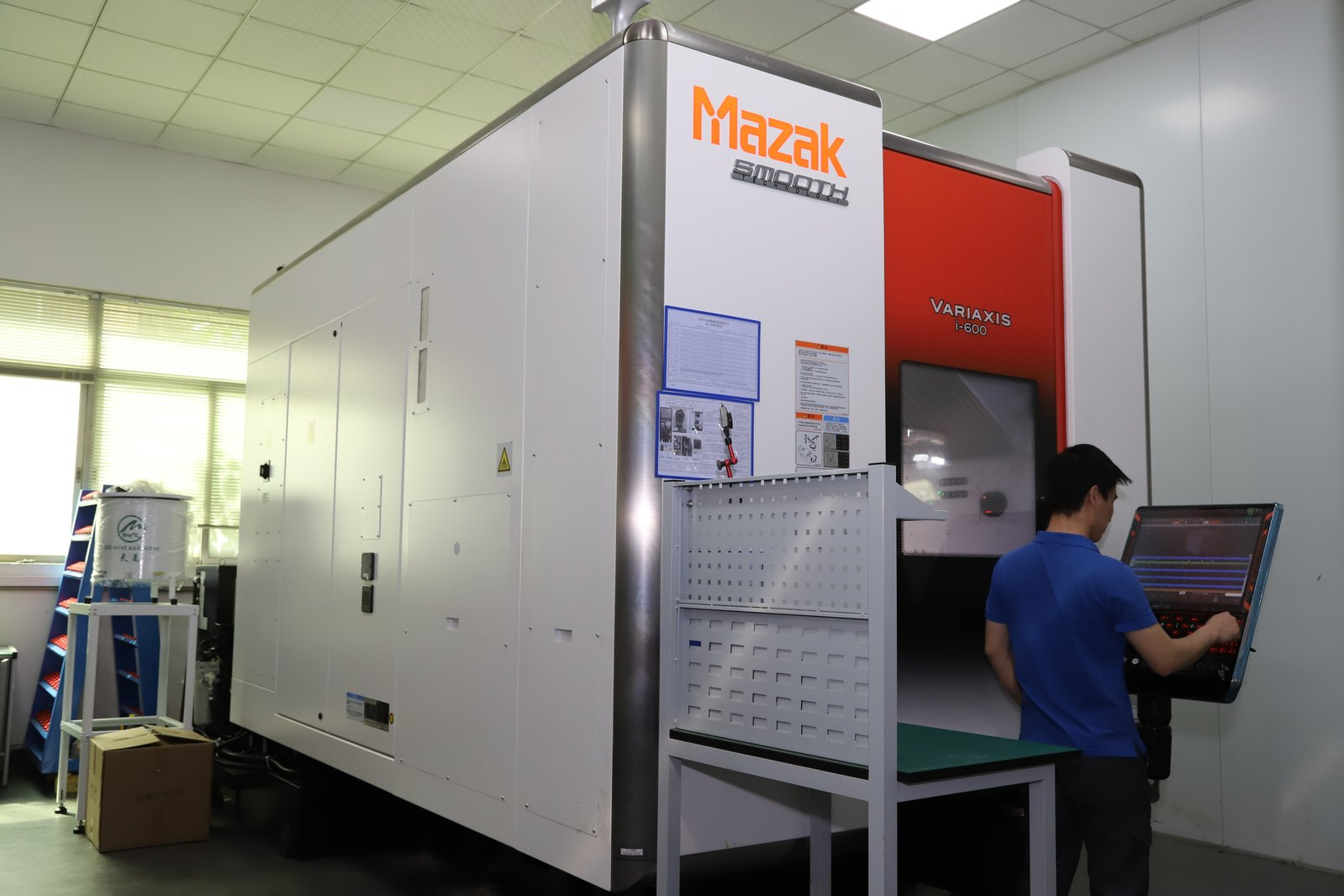
- 5-axis machining centres (10+) - Mazak VARIAXIS I-600 (510/910/510 mm travel, 12,000 rpm, 22 kW, 71.6 N·m, 30-tool BT40) and Mazak INTEGREX I-250H S (B-axis 0.0001°, 24 kW, 124 N·m, 38-tool HSK-A63). Intended for compound-angle parts, single-setup multi-face prismatic work, and aerospace fittings where datum transfer loss is unacceptable.
- 3-axis / 4-axis machining centres (50+) - Brother SPEEDIO S500Z2N / S700Z2N (10,000 rpm, 14/21-tool ATC, 0.7 s tool-to-tool, Z-axis 2.2 G) and Mazak VCE-430A L / VCE-570C L (10,000 rpm, 118 N·m, 24-tool ATC). Intended for prismatic parts, plates, brackets, housings.
- Swiss-type turning centres (10+) - Citizen Cincom A20-3F7 (Φ20 mm, 10,000 rpm), TSUGAMI B0206-III / B0205-III (Φ20 mm, 0.1 µm), STAR SR-32JII / SR-32J Type N (Φ32 mm, 8,000 rpm). Intended for long, slender rotational parts at ±0.002 mm.
- CNC turning centres (20+) - HEADMAN T70M/1250 (720 mm swing, 117 mm bore, 3,000 rpm, BMT75 12-station turret). Intended for shafts, bushings, flanges up to ±0.002 mm.
- Wire EDM (5+) - Sodick AQ535L (550/350/300 mm travel, ±20° taper, 800 kg workpiece). Intended for hardened tool steel, internal splines, sharp internal corners that milling cannot reach.
- Inspection: Hexagon CMM + 20+ gauges - Hexagon CMM for coordinate measurement, plus vision system, profilometer, hardness tester, coating thickness gauge, XRF for material verification. The 10:1 rule (gauge 10x more accurate than the band) is applied to every feature.
- Machine highlights - VARIAXIS I-600: one-setup multi-face 5-axis + MAZA-CHECK auto-calibration; INTEGREX I-250H S: DONE-IN-ONE mill-turn, B-axis 0.0001° + Ai thermal shield; SPEEDIO S500Z2N / S700Z2N: Z-axis 2.2 G + 0.7 s ATC; Swiss-type: guide-bush switchable + 0.1 µm resolution.
Tolerance: ±0.003 mm CNC milling / ±0.002 mm CNC turning / ±0.002 mm grinding and wire EDM. Capability: Ppk >= 1.67 initial on key characteristics, Cpk >= 1.33 ongoing.
Certificates: ISO 9001:2015 (116024/A/0001/UK/En), IATF 16949:2016 (131941/A/0001/SM/En, with design clause 8.3 excluded, stated openly) and ISO 14001:2015 (116024/B/0001/UK/En), issued to Dongguan Zhuohang Ltd, registration 91441900MA4UWT6X39, founded 2005.
Where we ship: Austria, Belgium, the Czech Republic, Denmark, France, Germany, Greece, Hungary, Ireland, Italy, the Netherlands, Spain, Sweden and the United Kingdom in Europe; Brazil, Canada, Mexico and the United States in the Americas; China, Israel, Japan, Singapore and Sri Lanka in Asia; Australia and New Zealand in Oceania; and South Africa in Africa — plus other countries and regions worldwide, shipped from our base in Dongguan, China.
Contact: Felipe Iglesias, [email protected], +86 13126536955.
Pull the cost levers with a DFM review
Send your drawing to [email protected] or call +86 13126536955 for cost-saving suggestions and an itemized quote.
Frequently Asked Questions
How does the service drive cost through selection?
In short, The DFM review pulls four levers before quoting: tolerance only on functional features, the cheapest alloy that meets the spec, the lowest-axis process the geometry allows, and a batch size that amortizes setup. The itemized quote reflects the reviewed choices.
Which machining services run in-house?
CNC milling (3-, 4-, and 5-axis), CNC turning, mill-turn, and precision grinding all run in-house. Surface finishing and some heat treatment are outsourced to qualified partners and disclosed rather than implied.
What tolerances does the service hold?
Milling and turning hold ±0.003 mm (milling) / ±0.002 mm (turning) and grinding holds ±0.002 mm, with Ppk ≥ 1.67 at the initial study on key characteristics and ≥ 1.33 on general characteristics, verified on Hexagon CMMs.
What is the minimum order quantity?
One piece. The service takes prototype and single-part orders as well as production runs, so you can validate a design on a first article before committing to volume.
How does batch size affect unit cost?
Setup and programming are fixed costs. On a one-off they dominate the unit price; as quantity grows they spread thin. With MOQ 1 piece, you prototype first, then scale on the same process.
What does the DFM review return?
In short, The DFM review returns cost-saving suggestions with the itemized quote. It assigns a tolerance, a material, and a process to each feature before any number is committed, so the price reflects the part you should make rather than the one the drawing accidentally asks for.
How do lead times work?
In short, Lead time is set by complexity and the number of process steps. Simple parts with few operations ship in about 3 days, standard parts in about 7, and complex parts with 10–20 steps or finishing in about 30.
How do I get a quote?
Email your STEP, IGES, or 2D drawing to [email protected]. The reply includes a DFM review with cost-saving suggestions and an itemized quote.
Continue reading: Online CNC Machining · Online CNC Machining Factory · Online CNC Machining Parts Manufacturer
Standards referenced on this page
- ASTM B211/B211M-19 — Standard Specification for Aluminum-Alloy Rolled or Cold Finished Bar, Rod, and Wire
- ASTM B348/B348M-21 — Standard Specification for Titanium and Titanium Alloy Bars and Billets
- ISO 9001 — Quality management systems — Requirements